Gartner Just Named the Category We've Been Building. Context Is How Enterprises Close the AI Value Gap.
By Leon Papkoff, Co-founder, President and CPO, Nth AI. Published 2026-11-24.
Gartner named AI context platforms a top strategic technology trend for 2027. Leon Papkoff explains why enterprise agents need shared definitions, current data and traceable answers, and how Nexus builds that foundation.
Think about your last great hire. Smart, eager and still wrong for the first month, because nobody had told them what "active customer" means at your company or which system finance actually trusts. Now picture onboarding them five times, with five different binders, and hoping all five agree. That is roughly how most enterprises are rolling out AI agents today.
On November 23, Gartner published "AI Context Platforms Help Close the Agentic AI Value Gap," and named AI context platforms one of its Top 10 Strategic Technology Trends for 2027. It reads like a transcript of the conversations we've had with customers all year.
The gap is real, and more agents won't close it
Gartner puts the problem plainly: 42% of enterprises plan to deploy AI agents by the end of 2026, yet only 22% currently capture significant value from GenAI.
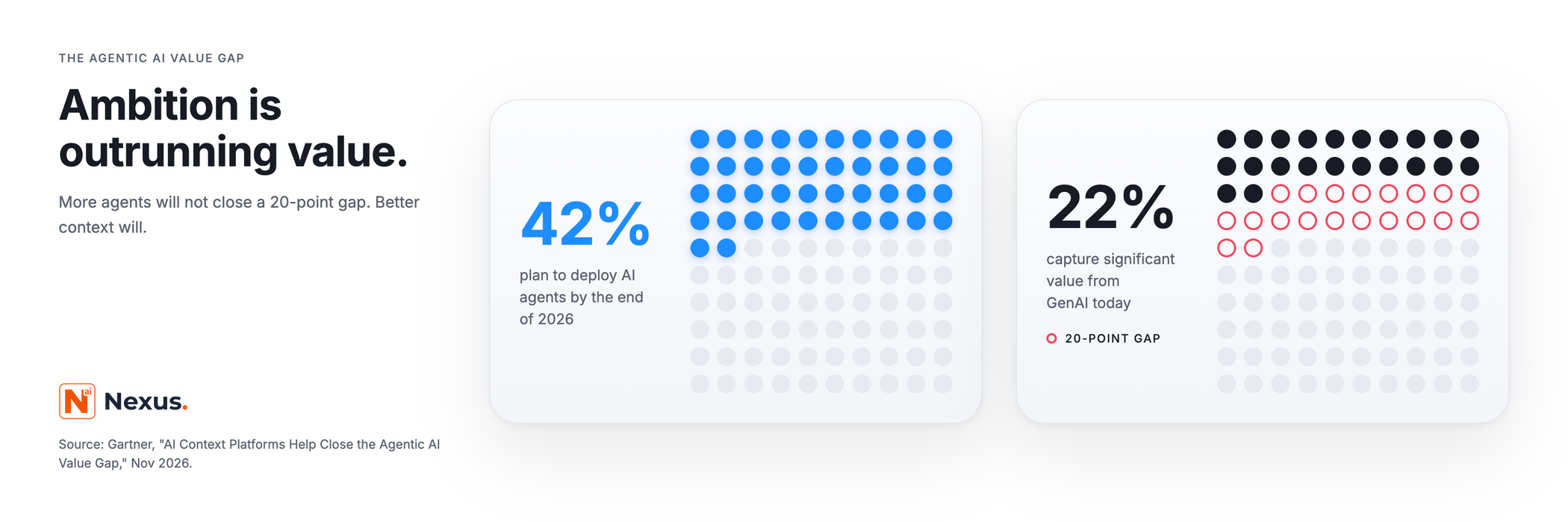
AI only knows what it's given, and your business lives in a dozen systems that disagree. Gartner names three causes: fragmented knowledge, hallucinations and rising compute costs.
The default reaction has been more agents and bigger models. But a brilliant hire with the wrong binder is still working from the wrong binder.
What Gartner means by "context"
Gartner defines an AI context platform as software that enables data and AI engineering teams to construct, govern and deliver semantically organized knowledge (taxonomies, ontologies, knowledge graphs) to AI agents. It maps structured and unstructured data to semantic models and delivers context at query time as grounded, cited output.
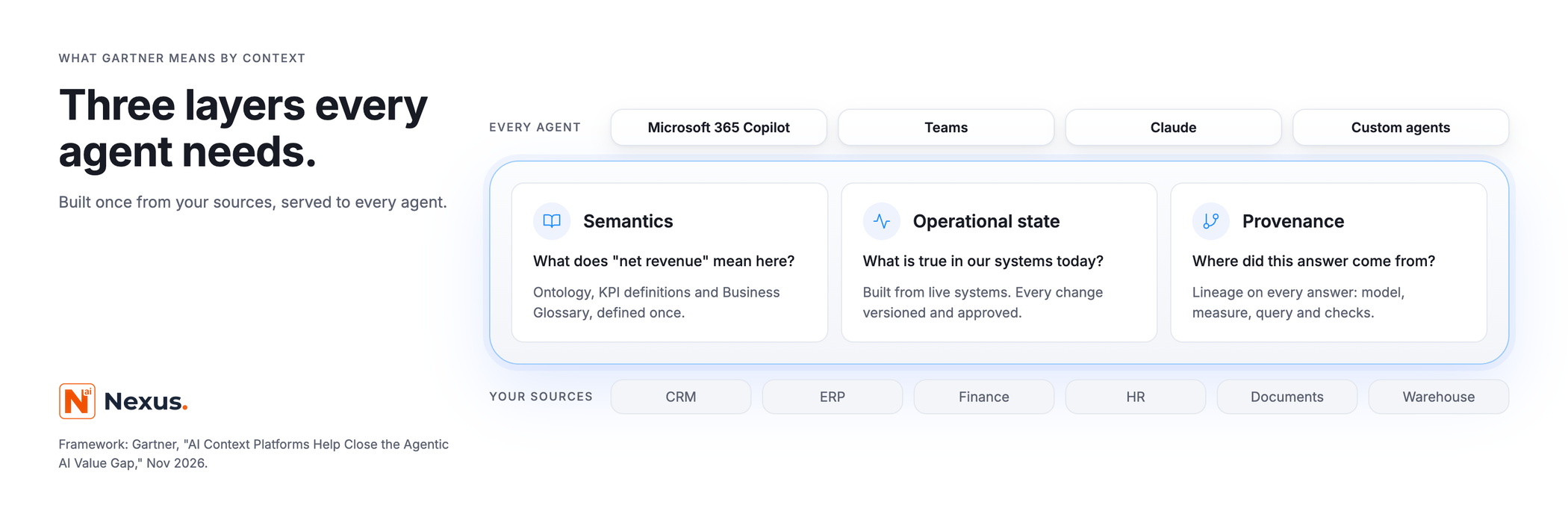
And it describes the enterprise context layer as a combination of three things: semantics, operational state and provenance.
The AI has to know what "net revenue" means in your business, what is true in your systems today, and where every answer came from.
The hidden cost of building context one agent at a time
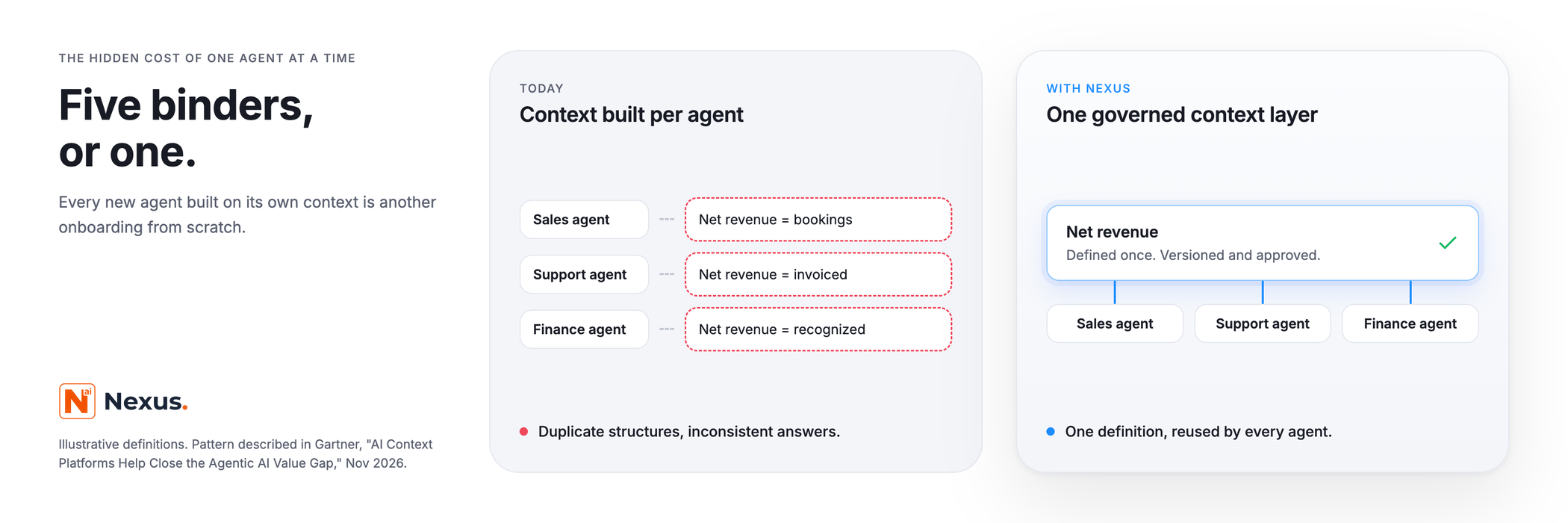
Gartner's sharpest observation is that many organizations build context separately for each agent: sales, support and finance each get their own setup. The result, as Gartner notes, is duplicate structures and inconsistent outcomes. Every new agent is another onboarding from scratch.
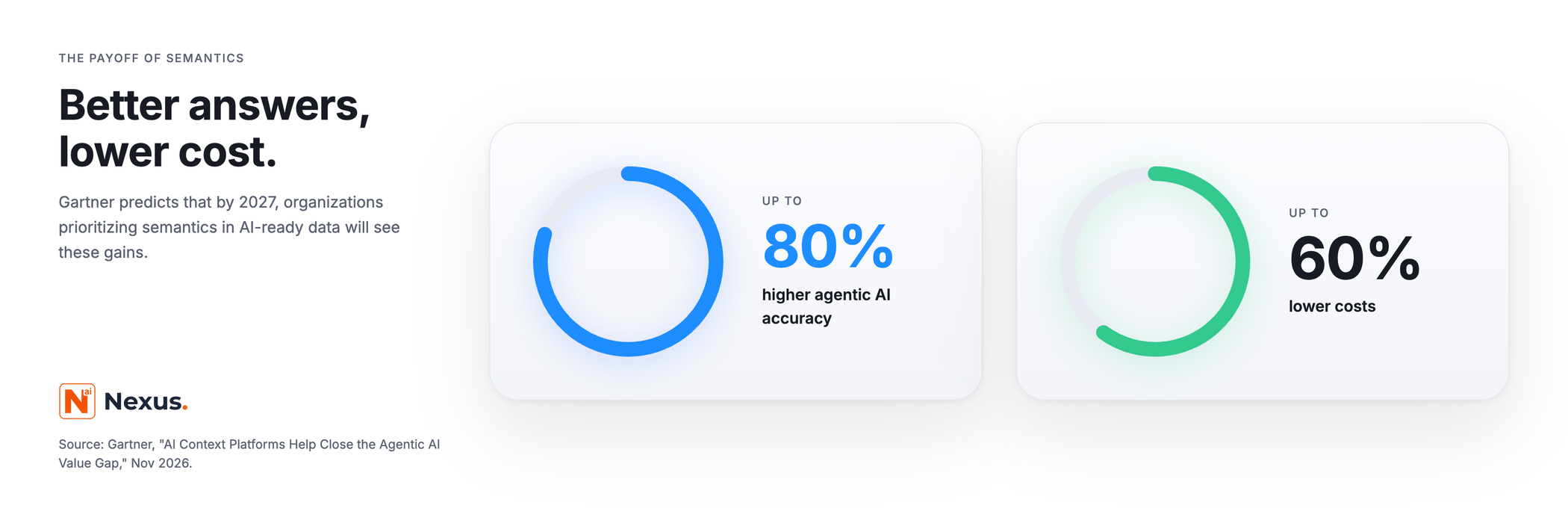
The payoff for fixing this is significant. Gartner predicts that by 2027, organizations prioritizing semantics in AI-ready data will increase agentic AI accuracy by up to 80% and cut costs by up to 60%.
Context is a discipline. Make it practical.
Gartner is careful here, and so am I. The article says no single vendor offers a complete AI context platform today, and it advises treating context as an enterprise capability, not a product feature.
I agree. You can't buy a shrink-wrapped understanding of your business. Software can make that discipline repeatable and governed.
That's why we built Nth AI Nexus, the context layer that teaches AI how your business actually works. Nexus installs from the Azure Marketplace as a managed application inside your own Azure tenant, on Microsoft Fabric and Azure AI Foundry. Nth AI never holds your data.
You describe your business in plain English and connect your sources. Nexus agents then build and maintain the stack: semantic models, KPI definitions, the ontology and the context layer itself. Every curated table is reconciled to its source. Every definition is versioned and approved. Golden questions, the ones your team agrees must always come back right, rerun on every build. When sources change, Nexus updates what depends on them. People make the judgment calls, Nexus does the implementation.
Semantics. The ontology, KPI definitions and Business Glossary capture what your business means. "Contract value" gets defined once, and every agent uses it.
Operational state. The layer is built from your live systems and stays current as they refresh. Change is managed like software: redefine a metric and the change is noted, versioned and approved, then every dependent measure and golden question reruns. Nothing reaches users until it passes.
Provenance. Every answer carries its lineage: the model, the measure, the query and the checks it passed. If a model isn't certified yet, Nexus says so. We never show a confidence score. Lineage shows you the work.
A semantic layer on top of your stores
Gartner warns that many vendors position context as data storage rather than semantics, operational state and traceability. That warning is the heart of the article.
Vector databases and knowledge graphs are useful, and Nexus uses them as inputs. But Nexus is the governed semantic layer on top: the definitions, the reconciliation, the approvals and the lineage that turn stored data into context an agent can rely on.
Built for trust, served where people already work
Agents propose, people approve. Nothing is created, changed or published in your tenant until a named person approves an exact plan, and code, not a model, decides what publishes. Every query signs in with Entra and runs as the person asking, so your source systems' row-level security carries through to every answer.
Nexus has no chat or dashboard product of its own. One governed MCP server serves the same context to Microsoft 365 Copilot, Teams, Claude and the custom agents your teams build. Copilot does the reasoning, Nexus supplies the truth.
Our tagline is "Every Source. One Truth." One truth is the starting line. What it enables is the point: agents you can rely on, decisions you can defend and apps your teams can build on with confidence.
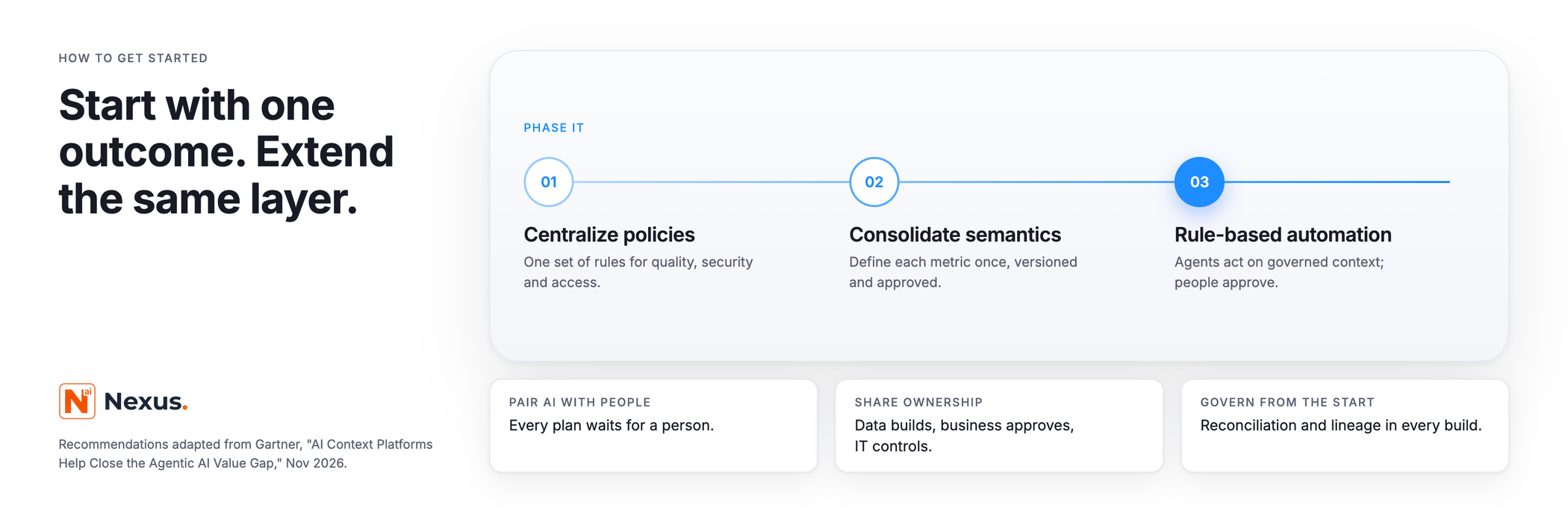
How to get started
Gartner's recommendations match how we work with teams:
- Phase it. Centralize policies first, then consolidate semantics, then move to rule-based automation. We start with one outcome, then extend the same layer.
- Pair AI with human expertise. Nexus agents do the modeling, and every plan waits for a person.
- Share ownership. With Nexus, data teams build, business owners approve and IT controls what lands.
- Govern from the start. Build in quality, security, traceability and auditability. In Nexus, reconciliation, lineage and the release gate are stages of every build.
As Andrés García-Rodeja, Senior Director Analyst at Gartner, puts it: "AI context platforms empower AI agents with the knowledge required for consistently reliable, cost-efficient and contextually relevant decision making."
That's the outcome that matters: agents you can rely on, all onboarded from the same binder.
Let's talk
If you're moving from agent pilots to agents that deliver real value, I'd love to compare notes. See a Nexus demo or talk to our team, and we'll show you a governed context layer on your own sources. Let's build!
Read the full Gartner article: "AI Context Platforms Help Close the Agentic AI Value Gap" (Gartner, Nov 23, 2026).